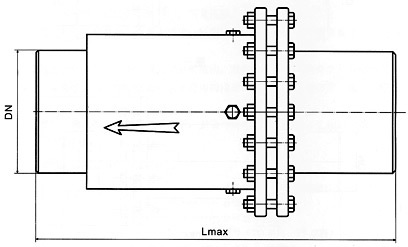
Compensator is a commonly used pipeline compensation equipment, which is mainly used to absorb the axial displacement caused by thermal expansion and contraction of pipelines, especially suitable for pipeline systems of hot water, steam and grease media. The following is an illustration of the basic structure and working principle of the sleeve compensator:
Structural composition
The sleeve compensator is mainly composed of the following parts:
Outer sleeve(Outer Tube): Usually a fixed external Tube fitting that provides structural support and protects internal components.
inner cannula(Inner Tube): An Inner Tube fitting that can slide inside the outer sleeve to achieve axial displacement.
Sealing packing(Packing): A sealing material located between the outer and inner sleeves, usually flexible graphite or other material suitable for high temperature environments, used to prevent media leakage.
gland(Gland): Used to fasten the sealing packing, maintain its tightness and prevent leakage.
limiting device(Limiting Device): Ensure that the inner sleeve does not move excessively to prevent damage to the compensator.
connecting flange(Flanges): The flange interface used to connect the compensator to the piping system.
Working Principle
When the pipeline is displaced due to thermal expansion and contraction, the inner sleeve slides in the outer sleeve along the axial direction, and adapts to the displacement through the compression and relaxation of the sealing packing, thus absorbing the thermal expansion or contraction of the pipeline. The limiting device ensures that the movement of the inner sleeve is within a safe range to avoid damage caused by excessive displacement.
Principle of sealing
The self-pressure sealing principle of sealing packing makes the sleeve compensator maintain good sealing performance even in high pressure and high temperature environment. The material selection of sealing packing is very important, and it needs to have good temperature resistance, sealing and self-lubrication to reduce friction and wear and ensure long-term stable sealing effect.
Maintenance
The maintenance of the sleeve compensator mainly involves regular inspection of the wear of the seal packing and adjustment or replacement if necessary to ensure seal performance. In addition, check the effectiveness of the limiting device to prevent damage caused by excessive displacement.
Illustration